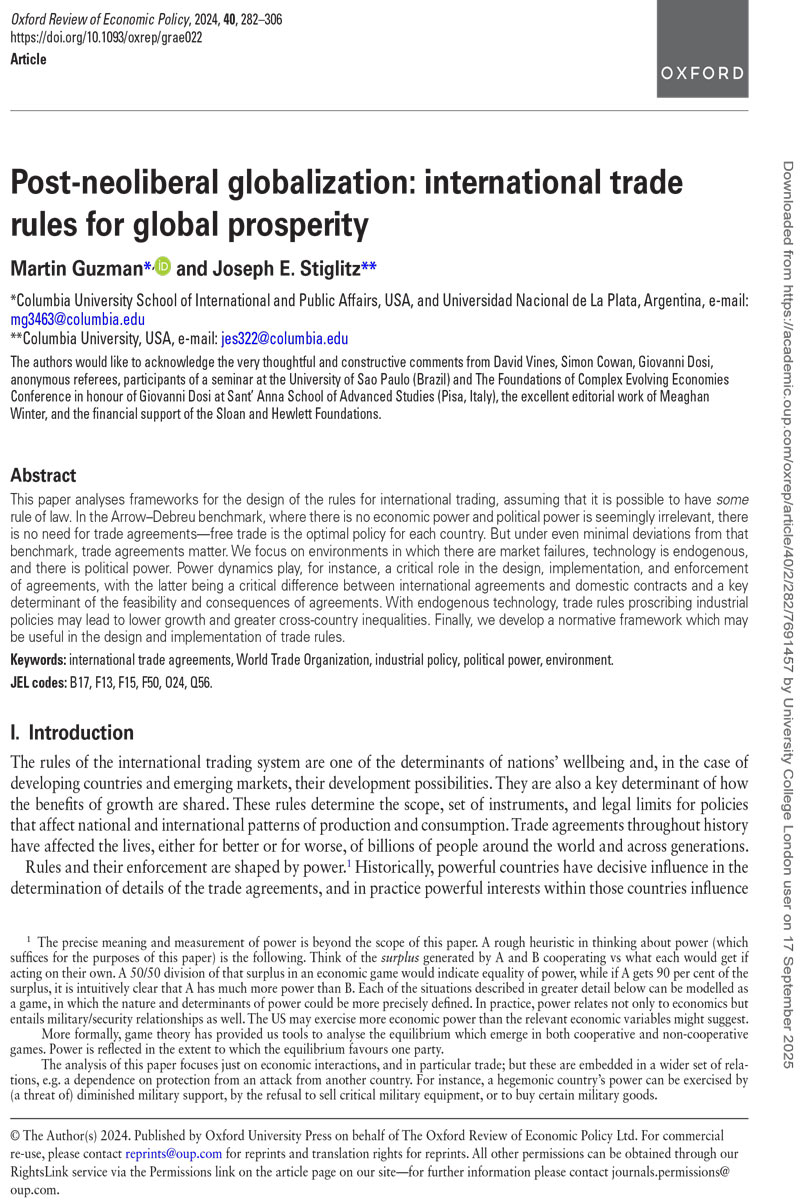
Assuming a rule of law, international trade agreements become crucial when deviating from the optimal free trade ideal of the Arrow–Debreu benchmark. This paper analyzes trade rules considering market failures, endogenous technology, and political power. Power dynamics are critical in designing and enforcing agreements, unlike domestic contracts. Rules restricting industrial policies may hinder growth and increase inequality. Finally, the study develops a normative framework to aid the design and implementation of effective and equitable international trade rules.