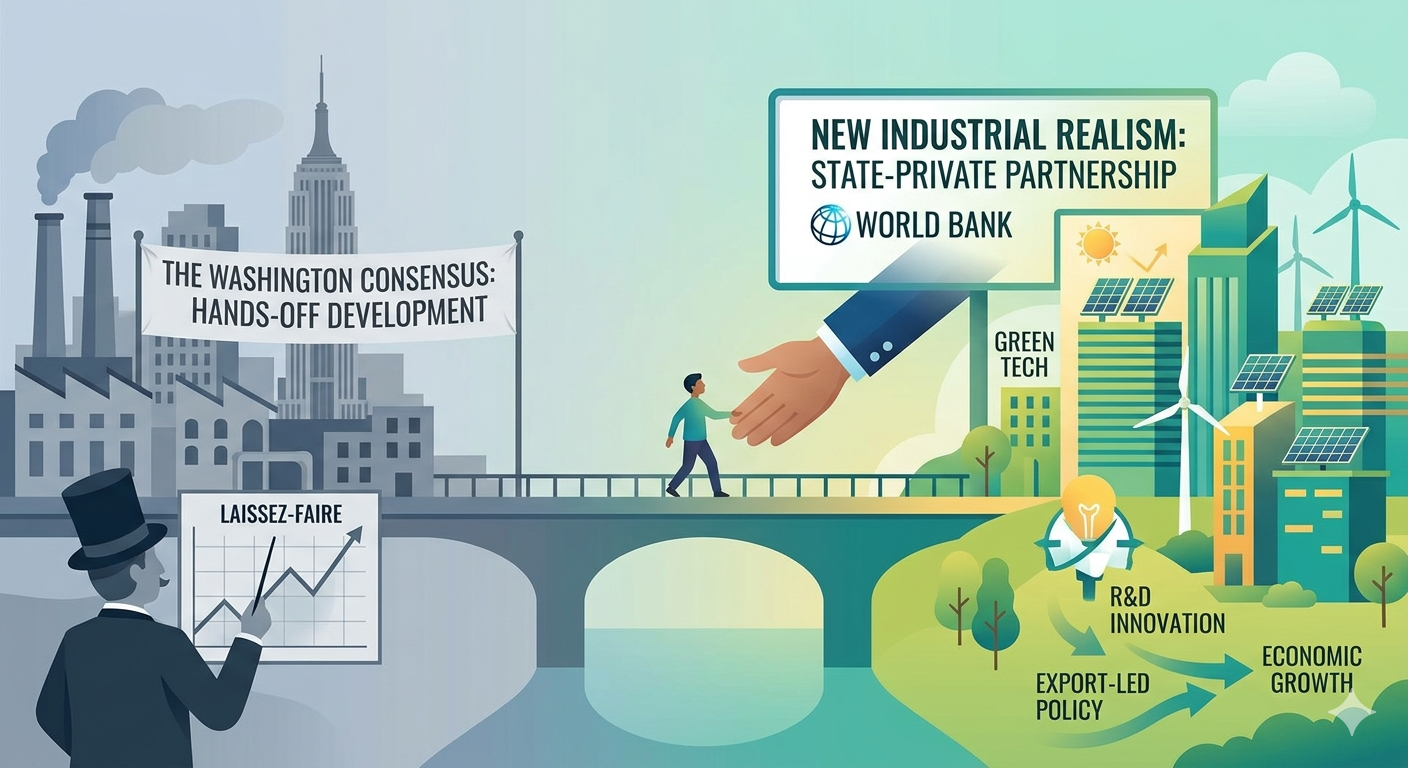
For decades, mainstream economics viewed government intervention in markets with skepticism, often warning against the perils of “picking winners.” However, a series of flagship reports from the World Bank—most notably the World Development Report 2024—signal a profound shift. The Bank now argues that for developing nations to escape the “middle-income trap,” a passive approach to markets is no longer sufficient. Instead, a disciplined, strategic industrial policy is essential for structural transformation (World Bank, 2024a).
The 3i Framework: Investment, Infusion, and Innovation
The core of this new advocacy lies in the “3i strategy.” While low-income countries focus on Investment, middle-income countries must transition to Infusion—the active diffusion of foreign technologies into the domestic economy (World Bank, 2024a). The World Bank posits that markets alone often fail to facilitate this leap due to information asymmetries and coordination gaps. Therefore, government intervention is required to “infuse” global best practices into local firms, preparing them for the final stage: Innovation. This transition is supported by the Business Ready (B-READY) framework, which emphasizes that a healthy private sector requires not just deregulation, but proactive public institutions that provide essential services and oversight (World Bank, 2024b).
Beyond Protectionism: Competitive Discipline
This is not a return to the failed protectionism of the past. The World Bank’s vision for industrial development is grounded in competitive discipline. Rather than shielding domestic “national champions” from global competition, the Bank advocates for policies that support sectors with high “technological relatedness” to a country’s existing strengths (World Bank, 2024c). By using trade data to identify these areas, governments can provide targeted public goods—such as specialized infrastructure, technical training, or R&D credits—that lower costs for entire industries rather than favoring individual politically connected firms.
Conclusion: The State as Catalyst
The long-standing “prohibition” against industrial policy is being replaced by a nuanced realism. The World Bank now views the state as a necessary catalyst to overcome market failures that stall growth. This modern approach suggests that while the state should not run the market, it must strategically steer it toward modernization to ensure productivity gains are sustained and inclusive.
Disclaimer: This AI-generated article is based on the cited references for discussion purposes. For further insights, please refer to the primary sources provided.
Sources
-
World Bank (2024a). World Development Report 2024: The Middle Income Trap. https://openknowledge.worldbank.org/entities/publication/9f8098d5-fa1f-4c1b-97b5-f04262818bb3
-
World Bank (2024b). Business Ready (B-READY) 2024 Report.
https://openknowledge.worldbank.org/entities/publication/bcb44e7a-f5eb-45ef-8dd0-225006c80cb3 -
World Bank (2024c). Industrial Policy: A Guide for the Perplexed.
https://openknowledge.worldbank.org/entities/publication/92a5a64a-68e5-51ce-ae64-c811e6fb1a8a -
Juhász, R., Lane, N. J., & Rodrik, D. (2023). The New Economics of Industrial Policy.
NBER Working Paper (Supplemental context on the global shift in economic thought).