Jakarta, Indonesia
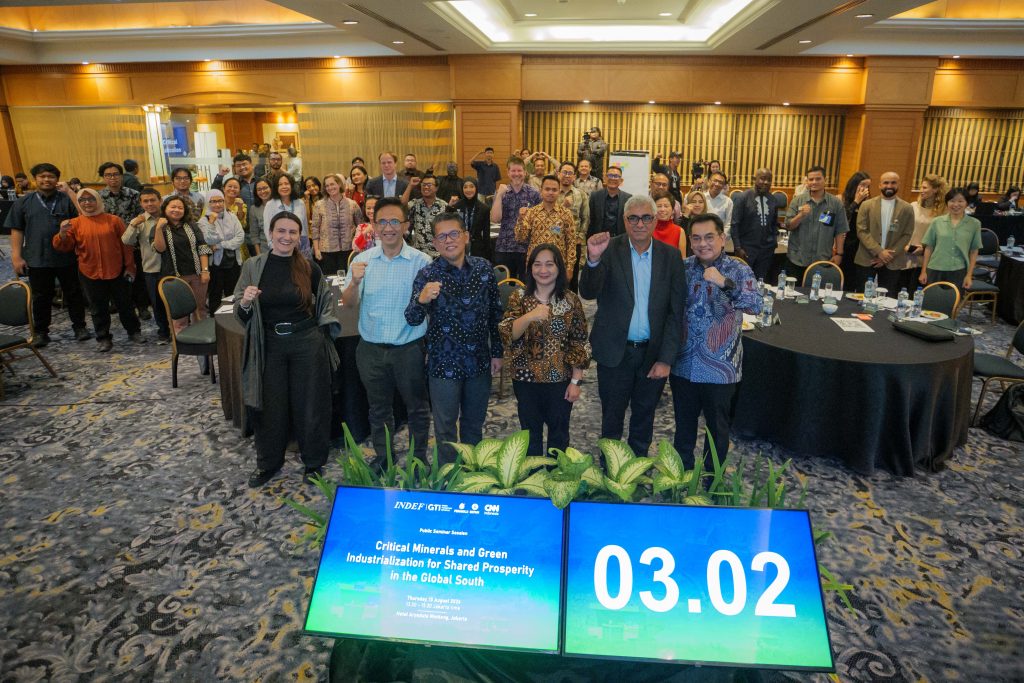
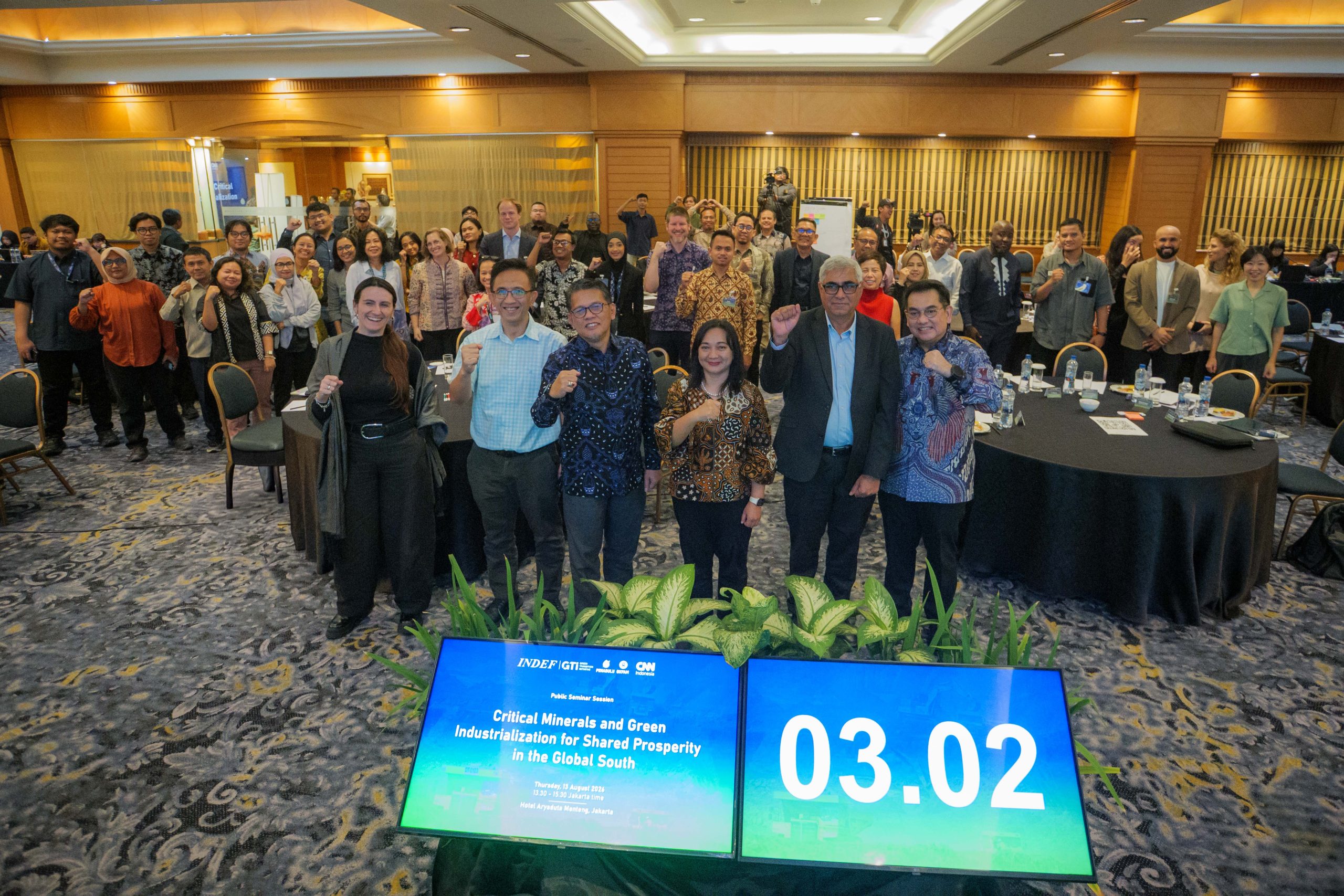
More than 50 policy experts, researchers, and representatives of civil society organizations from Asia, Africa, and Latin America gathered in Jakarta on August 12–13, 2026, for the Global South Dialogue on Critical Minerals and Green Industrialization.
Held at the ARYADUTA Menteng Hotel, the two-day dialogue brought together the community of practice on governance and green economics to discuss one of the most pressing issue of the day: how can countries that host the minerals needed for the green economy capture a greater share of the value of those minerals?
The meeting, co-organized by the INDEF Green Transition Initiative (INDEF GTI) and Penabulu-Oxfam, sought to move the conversation beyond the familiar debate over securing mineral supplies. At its centre was a broader question of development: how can critical minerals become a foundation for industrialization, technological upgrading, and shared prosperity in the Global South, rather than another source of dependence on the export of raw commodities?
The answer, participants argued, will require resource-rich countries to work together and develop a common policy agenda. The two-day dialogue therefore culminated in the formulation of the Jakarta Agenda, a proposed framework for strengthening the bargaining position of mineral-producing countries and ensuring that the green transition delivers broader economic and social benefits.
The Opportunity and Risk of the Critical Minerals Boom
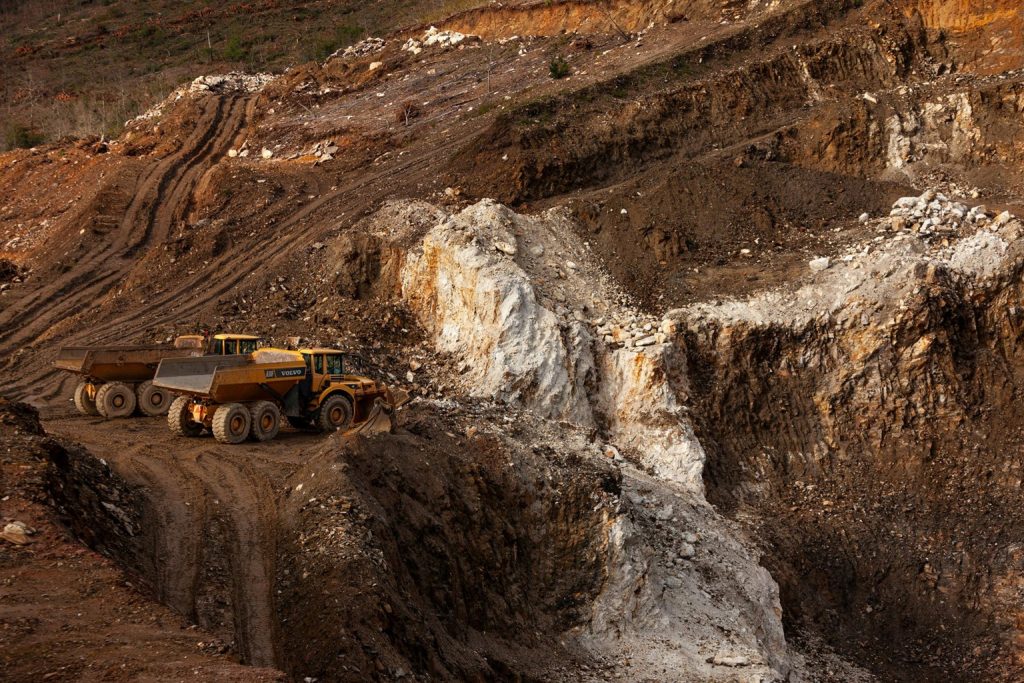
The global shift towards renewable energy is rapidly changing the strategic importance of minerals. Lithium, cobalt, nickel, copper, graphite, and rare earth elements are increasingly essential to electric vehicles, batteries, renewable energy systems, electricity grids, and other clean technologies.
The resulting surge in demand presents a significant opportunity for countries endowed with these resources. Yet it also carries a familiar risk. Without deliberate industrial policies, countries of the Global South hosting the minerals could remain primarily exporters of raw minerals while the higher-value stages of processing, manufacturing, technology development, and innovation take place elsewhere.
This concern was central to the dialogue. Participants stressed that the clean energy transition should not simply replace one form of commodity dependence with another.
“Critical minerals can become a pathway to structural transformation, industrial upgrading, and shared prosperity,” the forum’s background framework noted. Achieving that outcome, however, requires mineral governance to look beyond extraction and place greater emphasis on domestic value creation, technological capabilities, environmental protection, and the interests of communities living in mining regions.
The scale of the opportunity is considerable. World Bank estimates suggest that mineral production could increase by nearly 500 percent by 2050 if the world is to meet the mineral requirements of the clean energy transition. For mineral-rich countries, the question is therefore not whether demand will grow, but how they can use that growth to support long-term development.
Learning from Experiences Across the Global South
The dialogue combined a public seminar, titled “Critical Minerals for Shared Prosperity in the Global South,” with five closed-door thematic workshops conducted under the Chatham House Rule. The format allowed participants to discuss both the opportunities and challenges associated with mineral-based industrialization while drawing on experiences from different regions.
Discussions brought together experiences from countries at different stages of developing their mineral industries. Participants examined Mexico’s approach to lithium, community-benefit models emerging in Southern Africa, and Indonesia’s experience with downstreaming its nickel industry. Also in the discussion was the value addition conducted by GCC (Gulf Cooperation Council) countries over their minerals, and other minerals imported from outside the region.
As the host of the dialogue, Indonesia’s experience featured prominently in the discussions. Its efforts to promote domestic processing have significantly altered the country’s position in the global nickel industry. Indonesia’s share of global nickel production rose from around 31.5 percent in 2020 to approximately 60 percent in 2024.
The experience demonstrates both the potential and complexity of downstream industrial policy. Moving beyond the export of raw materials can create opportunities for investment, manufacturing, employment, and technological development. At the same time, such policies need to be accompanied by strong environmental standards, social safeguards, effective governance, and mechanisms to ensure that the benefits of industrialization are broadly distributed.
For participants, these lessons reinforce the importance of countries learning from one another rather than pursuing mineral strategies in isolation.
The Jakarta Agenda
The discussions culminated in the Jakarta Agenda, developed from the deliberations of the thematic workshops. Rather than serving simply as a statement of principles, the agenda is intended to provide a foundation for continued policy dialogue, research, and cooperation among countries of the Global South.
The framework rests on five interconnected priorities.
1. Domestic Value-Chain Development: Building midstream processing capabilities and integrating minerals into domestic manufacturing.
2. Strategic Partnerships: Securing international investment, technology transfer, and innovation financing while protecting national policy flexibility.
3. Policy Coherence: Aligning fiscal incentives, industrial growth, trade strategies, and environmental protections.
4. Community and Environmental Safeguards: Embedding transparency, local benefit-sharing, and transnational accountability across supply chains.
5. Regional Cooperation: Strengthening South–South alliances to build collective bargaining power, shared standards, and joint infrastructure.
From Mineral Wealth to Industrial Transformation
Underlying the Jakarta Agenda is a broader shift in how critical minerals are understood. For many years, discussions about minerals in the global economy have largely focused on the security of supply for major consuming countries. The Jakarta dialogue sought to place the development interests of producing countries at the centre of the conversation.
That shift matters because the geography of mineral resources and the geography of technological capabilities remain highly uneven. Many countries in the Global South possess substantial mineral resources but continue to capture only a limited share of the value generated by global supply chains.
The challenge is therefore not simply to extract more minerals. It is to use mineral wealth to build productive capabilities: processing industries, manufacturing capacity, technology, skilled employment, research and development, and stronger domestic enterprises.
This will not be easy. Global trade rules, competition for investment, geopolitical tensions, environmental pressures, and rapidly changing technologies will all shape the choices available to mineral-producing countries. There is also no single model that can be applied across countries with very different institutional capacities, resource endowments, and economic structures.
But participants at the Jakarta dialogue agreed on one fundamental point: countries of the Global South have greater leverage when they act collectively.
Closing the dialogue, Prof. Antonio Andreoni of SOAS University of London emphasized the importance of cross-border collaboration in enabling emerging economies to develop resilient and sustainable green industries.
The Jakarta Agenda is an attempt to turn that principle into a shared platform. Its significance will ultimately depend not on the declaration itself, but on whether it can lead to sustained cooperation, stronger policy coordination, and concrete action.
As the global race for critical minerals intensifies, the countries that possess these resources have an opportunity to shape more than the supply of the green economy. Working together, they can also seek to shape who benefits from it.
—————————————
Disclaimer: The article is assisted by AI for the language clarity and grammar.
—————————————