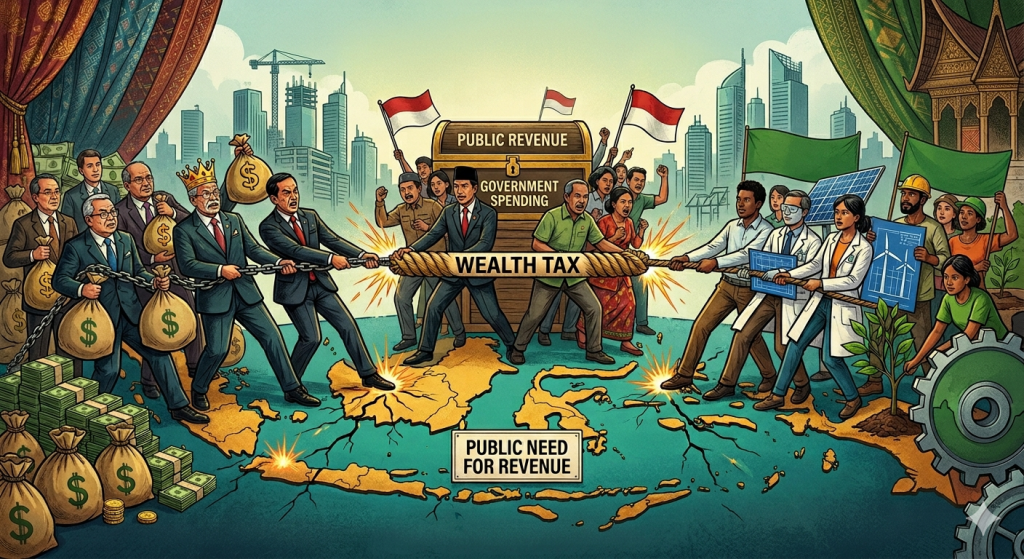
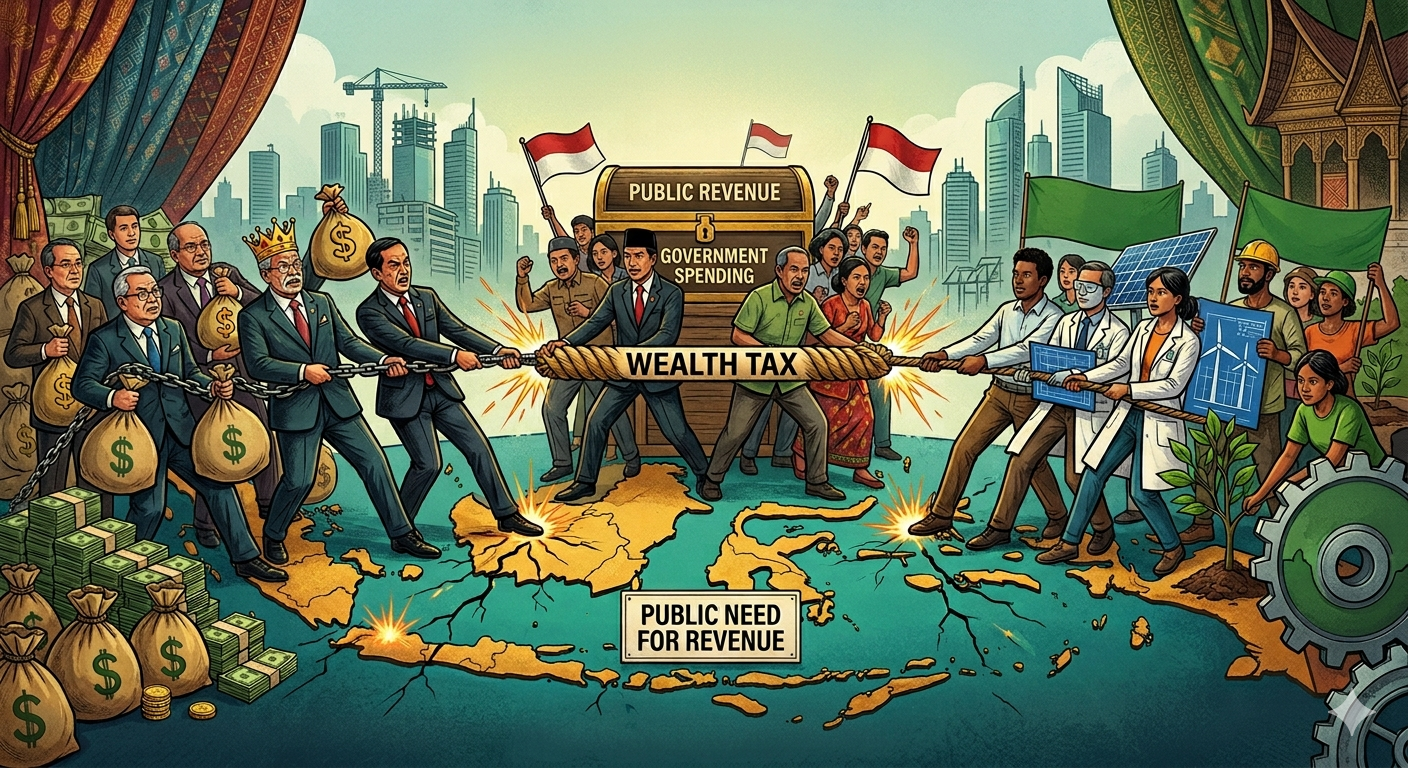
The debate over wealth tax in Indonesia has intensified in recent years due to rising economic inequality, fiscal pressures, and demands for a fairer tax system. A wealth tax generally refers to an annual levy on net assets owned by high-net-worth individuals, including property, financial assets, and luxury holdings. Supporters argue that Indonesia’s tax system relies too heavily on consumption taxes and labor income, while large concentrations of wealth remain lightly taxed. Increasing public concern over inequality after the COVID-19 pandemic and the global discussion on taxing the ultra-rich have also contributed to the growing relevance of the issue in Indonesia (Putri & Marfiana, 2026; OECD, 2024).
One major cause behind the emergence of the wealth tax issue is the widening gap between rich and poor households. Indonesia has experienced significant wealth concentration among elite business groups, especially in sectors such as mining, property, banking, and digital platforms. At the same time, the government faces growing expenditure needs for infrastructure, energy transition, and social welfare programs. International institutions such as the OECD have highlighted that wealth inequality is often more severe than income inequality because capital accumulation grows faster over time than wages (OECD, 2018). The perception that wealthy individuals can avoid taxation through financial engineering and overseas assets has strengthened demands for a more progressive fiscal system (OECD, 2018; Arianty, 2026).
The politics surrounding wealth tax in Indonesia are highly sensitive. Political parties on the center-left tend to frame wealth taxation as a tool for redistribution and social justice, while business associations and market-oriented groups often warn about risks to investment and entrepreneurship. Wealth tax proposals may face strong resistance from economic elites who possess considerable political influence through party financing and ownership of strategic industries. Experiences in Europe also show that wealth taxes often become politically controversial because wealthy taxpayers can relocate assets or shift investments abroad. Critics in Indonesia argue that the country’s administrative capacity and asset-tracking systems remain weak, making implementation vulnerable to evasion and corruption (Putri & Marfiana, 2026; Everhart, 2026).
In terms of mechanics, implementing a wealth tax in Indonesia would require several institutional reforms. The government would first need a comprehensive registry of financial and non-financial assets, including property ownership, offshore wealth, company shares, and luxury assets. Most proposals suggest that the tax should only target very wealthy individuals above a high threshold to avoid burdening the middle class. Economists also emphasize the importance of international information exchange to prevent capital flight and tax avoidance. Asset valuation represents another challenge because private companies, land holdings, and family businesses are difficult to price accurately. Administrative costs may therefore become high relative to the revenue collected, as observed in several OECD countries that eventually abolished wealth taxes (OECD, 2018; Arianty, 2026).
The relevance of wealth tax to Indonesia’s current economic condition is increasingly significant. Indonesia aims to maintain fiscal stability while simultaneously funding industrial downstreaming, food security, and welfare expansion. The government also seeks to improve tax compliance as part of broader structural reforms connected with OECD accession and international tax standards. However, Indonesia still faces a relatively low tax-to-GDP ratio compared with many emerging economies. Advocates believe that a carefully designed wealth tax could strengthen state revenue without increasing the burden on low-income households. Opponents, however, fear that the policy could reduce investor confidence at a time when Indonesia is competing for foreign capital and industrial investment (OECD, 2026; Reuters, 2025).
The wealth tax debate is also connected to Indonesia’s ambition to finance green industrial projects and energy transition programs. The government is investing heavily in renewable energy, electric vehicle supply chains, geothermal development, and green industrial estates linked to nickel processing. These projects require substantial long-term financing, while fiscal resources remain limited. Some policy analysts argue that progressive taxation on extreme wealth could help finance green transformation initiatives and reduce inequality simultaneously. Indonesia’s sovereign investment institutions, including INA and Danantara, have already prioritized renewable energy and green industrial development. In this context, wealth tax proposals are increasingly discussed not only as redistribution instruments but also as mechanisms to mobilize domestic resources for sustainable development (Reuters, 2025; Financial Times, 2024).
Overall, the wealth tax debate in Indonesia reflects broader tensions between economic equality, fiscal sustainability, and investment competitiveness. While the policy could provide additional revenue and support redistribution, practical challenges related to asset valuation, enforcement, and political resistance remain substantial. Indonesia’s future approach will likely depend on whether policymakers can design a system that balances fairness with economic efficiency while supporting the country’s long-term development and green industrial transformation (OECD, 2018; Everhart, 2026).
Disclaimer: This AI-generated article is based on the cited references for discussion purposes. For further insights, please refer to the primary sources provided.
Sources
- Putri, A. P., & Marfiana, A. (2026). Assessing the urgency and feasibility of wealth tax implementation in Indonesia. Educoretax.
Educoretax Article - Arianty, F. (2026). Implementation of Wealth Tax in Indonesia: Analysis of Potential and Challenges From a Socio-economic Perspective. KnE Social Sciences.
ResearchGate Publication - OECD. (2018). The Role and Design of Net Wealth Taxes in the OECD.
OECD Wealth Tax Report - OECD. (2024). Taxation and Inequality.
OECD Taxation and Inequality Report - OECD. (2026). Indonesia Economic Snapshot.
OECD Indonesia Economic Snapshot - Everhart, J. R. (2026). The complexity in implementing wealth taxes and a recommended alternative United Nations economic policy reform strategy for developing economies.
Taylor & Francis Article - Reuters. (2025). Indonesia sovereign wealth fund INA targets data centres, AI in healthcare, renewables.
Reuters INA Article - Reuters. (2025). Danantara and China’s GEM to develop nickel processing hub in Indonesia.
Reuters Danantara Article - Financial Times. (2024). Indonesia’s sovereign wealth fund eyes green energy transition in $1bn investment plan.